Gifu, Japan · The Northern Alps
Shirakawa-go Light-Up: Reservations and Winter Access
Shirakawa-go’s winter light-up is a reservation-based event, not an evening visit you can add spontaneously to a daytime trip. Confirm the official event date and your authorised access arrangement before booking transport. A normal village visit, a daytime bus ticket and a special-event reservation are different things.
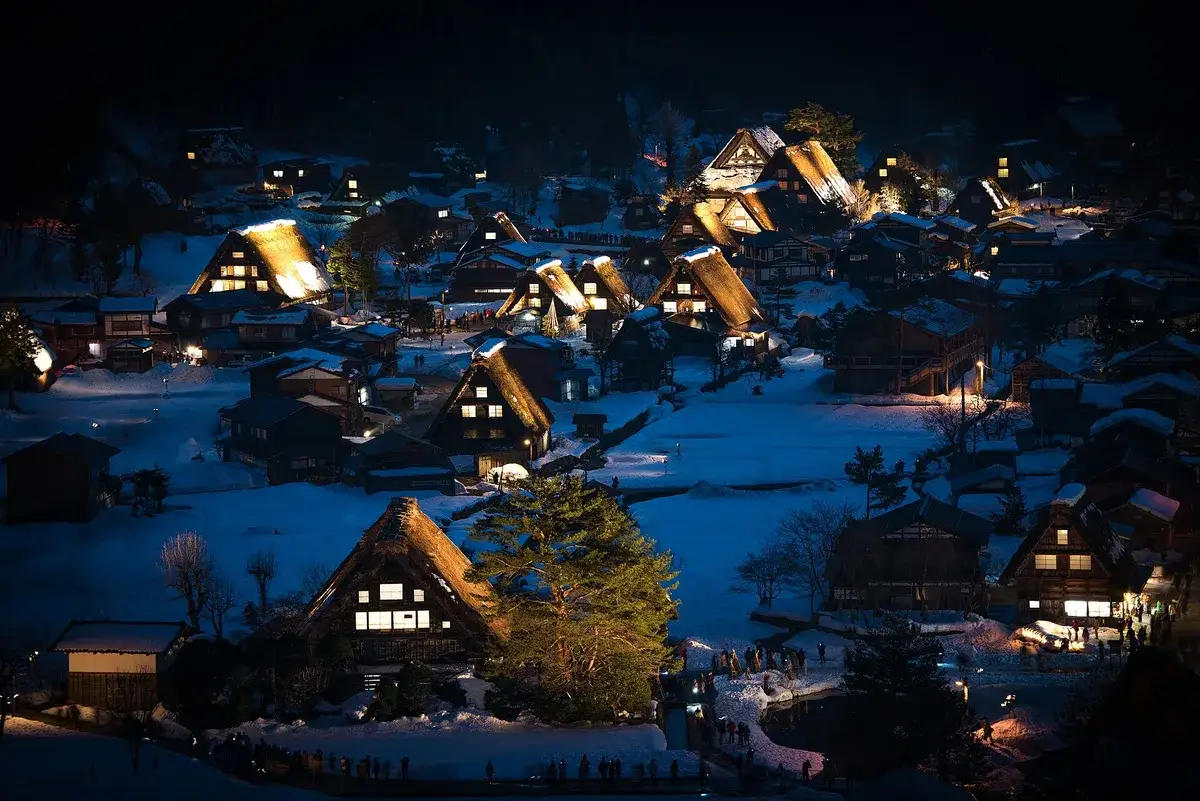
Archive winter evening view of Shirakawa-go. Ordinary daytime travel does not include reserved light-up or observation-deck access. · Jordy Meow · CC BY-SA 3.0 · Wikimedia Commons · Resized and converted to WebP
Some booking links may earn us a commission at no extra cost to you. How we fund this guide.
Which reservations include village entry or viewpoint access?
The current organiser overview separates event admission from the observation deck. Deck tickets are limited to qualifying stay plans and specified operator tours; confirm the exact product. | Reservation type | Village event entry | Observation deck | | — | — | — | | Qualifying event stay plan | Confirm included admission | Only the specified inclusive plan | | Official operator event tour | Check the selected option | Some options include it; others do not | | Designated event parking | Under current reservation conditions | Not included | | Ordinary hotel or daytime bus | Not established | Not established |
How does admission work?
The official event announcement requires advance reservations and states that visitors without them will not be admitted. Start with the current event notice, then identify the reservation route appropriate to how you plan to arrive. Do not travel to the village hoping to arrange entry at the roadside.
Admission to the village event and access to a particular viewpoint should be checked separately. A product described as a light-up tour may not include every photograph location shown in its marketing.
Should you book a tour, parking or accommodation?
Compare the authorised arrangements described by the organiser. A tour can solve the evening return journey if it actually includes event admission. Drivers need the correct event parking arrangement rather than ordinary daytime parking assumptions. Accommodation plans may have separate application conditions and transport responsibilities.
Read the confirmation for your exact date and party size. A nearby hotel reservation is not itself proof of admission. Save the organiser’s instructions offline and carry whatever confirmation the booking requires.
Can you return to Okuhida afterwards?
Do not assume ordinary evening buses will connect back to your ryokan after the event. Work backwards from your accommodation and identify every leg after the illumination ends. A tour returning to Takayama may still leave you without a useful onward connection into Okuhida.
An overnight base at the confirmed tour return point can be easier. If you stay at a ryokan, discuss late arrival and meal implications before booking. Paying for an elaborate dinner you cannot attend is an avoidable mismatch.
What should you prepare for the evening?
Bring footwear suited to winter surfaces and layers for waiting outdoors. Keep essential documents and phone power accessible. Give your group a meeting point and follow staff directions instead of pursuing a last photograph at the expense of the departure.
Dates, access restrictions and entry arrangements can change between winters. This page deliberately directs you to the current organiser notice rather than reproducing an old calendar. If admission is unavailable, consider an ordinary daytime winter visit instead of an unapproved evening arrival.
Keep a copy of the confirmed admission arrangement with the person managing the group. Everyone should know the departure meeting place before separating for photographs.
Is the light-up the same as ordinary winter sightseeing?
No. The winter light-up is a separately organised event with advance reservation requirements. A daytime sightseeing ticket, a normal bus journey or a photograph of snowy houses does not establish entry. The official event announcement explicitly warns that visitors without the required reservation are not admitted. Start with the event organiser’s latest detailed instructions for the intended winter, rather than an old tour article. Dates, booking routes and transport arrangements can change between editions. A general schedule announcement may also be followed by a more detailed reservation guide, so read the linked updates before paying.
If you simply want snowy village scenery, consider an ordinary daytime visit with suitable transport. That is a valid winter experience without the event’s evening arrangements. If illumination is the reason for travelling, build the surrounding itinerary around a confirmed event booking. Do not arrive on a daytime service hoping that admission can be added informally after dark.
Which booking must you secure before arranging the rest of the trip?
Secure a legitimate event-access arrangement that matches the organiser’s current rules, then fit accommodation and onward transport around it. Depending on the official process, different products may bundle admission, transport or a local stay in different ways. Read what your selected reservation actually establishes.
Keep separate notes for event entry, transport to and from the village, accommodation and any viewpoint entitlement. Do not assume one confirmation answers all four. If a seller advertises a package, ask it to identify the included event arrangements in writing. If a property offers an event-related stay, read its specific conditions rather than applying the rules of an ordinary night.
Before buying, check that the dates on every part agree. Winter event arrangements are not interchangeable across evenings. A booking system displaying availability for Shirakawa-go generally may be offering ordinary sightseeing. Use the official instructions as the reference when comparing packages, and avoid committing to a non-flexible hotel solely because an activity platform shows an attractive illumination photograph.
Does every light-up booking include the observation viewpoint?
Do not assume it does. Village event access and access to a particular elevated viewpoint can be separate questions. Read the organiser’s current viewing arrangements and your package’s explicit inclusions. A famous panoramic image on a sales page is not evidence that your reservation includes that position. Ask the seller which viewing areas are included, how you reach them and whether access depends on weather or local restrictions. Confirm any additional timing, ticket or transport arrangement through the current official process. If the answer remains vague, choose the booking on the assumption that the extra viewpoint is not established.
Set expectations within the group before travel. Some visitors mainly want to walk among the illuminated houses; others are travelling for one specific panorama. Those priorities can lead to different choices. A package is suitable only when its actual viewing programme meets your reason for attending, with a route your group can manage in winter conditions and enough time to return to the agreed departure point.
Why is Takayama usually a more practical base than an Okuhida ryokan?
A Takayama base removes the additional mountain-village connection from the return plan when your chosen event transport finishes there. Okuhida may still belong elsewhere in the holiday, but it should not be treated as a convenient late-evening extension without a verified service.
Read the exact return point and expected programme finish before choosing the hotel. Even an advertised Takayama return does not guarantee a connection to another destination, especially when winter roads can delay the journey. Do not rely on an unplanned taxi to a remote ryokan or assume dinner will be held for an event return.
A practical sequence is to use a city night for the event and a separate night for the onsen stay. Compare Takayama accommodation near a workable arrival route, then arrange the journey to Okuhida on another day. This protects both experiences: the light-up can finish without a final village transfer, and the ryokan evening can begin early enough to enjoy its meal and baths.
What should you check about event transport?
Check the operator, meeting point, check-in procedure and return arrangement as carefully as admission. A regular daytime bus and a dedicated evening event service are different products. Make sure the confirmation names the actual event date and the transport you are permitted to use.
Ask whether there is a fixed departure point within the village, how far you must walk to it and what happens if someone is late. Save the instructions offline and share them with the whole party. A phone running low after an evening of photographs should not be the only place holding the return information.
For drivers, use the current event parking and access rules. Ordinary sightseeing parking arrangements may not apply on event evenings, and arriving in a private car does not bypass reservation requirements. Avoid planning a spontaneous drive after an unsuccessful ticket search. The correct response to missing event access is to choose another date or a normal daytime visit, not to travel there hoping that the rules will differ at the entrance.
How should you prepare for cold, snow and slower walking?
Dress for an outdoor evening with time spent standing as well as walking. Keep warm layers, gloves and weather protection accessible, and choose footwear for the conditions described by the organiser. A short village circuit can feel much longer when surfaces are slippery or the group stops frequently for photographs.
Keep belongings compact and hands as free as possible. Carry a charged phone and any essential items for the full return journey. Do not assume every shop or indoor space will be available as a warming stop. Read the programme for meal arrangements instead of relying on a spontaneous dinner between viewing areas.
For children and older relatives, consider the whole evening from hotel departure to return. A coach seat does not remove the outdoor walking and waiting. Agree on a modest viewing plan and ask about the actual route if mobility is a concern. If the event conditions exceed the group’s comfort, a daylight visit on another day may be a better fit than forcing participation because the main photograph is appealing.
How do you compare a light-up tour without buying the wrong product?
Look for explicit event admission and a defined return journey on the selected date. Then compare village time, guide language, meeting point, viewing access and the cancellation policy. A general Shirakawa-go tour is not an event package unless the listing says so clearly.
The tour comparison guide explains the broader product types. For the light-up, use an even stricter reading of inclusions. Ask whether the product is a confirmed reservation or a request awaiting acceptance, and whether every member of your party is covered. Check child arrangements separately when the package includes seating or accommodation.
Do not infer current event availability from a generic affiliate module. Ordinary activities can help plan a daytime visit but should not be presented as light-up admission. If the exact package is unavailable, keep the official event process as the reference and consider another winter plan. A clear unavailability is more useful than a booking whose title looks relevant but does not establish the access you need.
What happens if weather affects the event or the road journey?
Follow the organiser’s latest notices and the transport provider’s instructions. The official announcement allows for cancellation when severe conditions threaten transport, so avoid describing the event as guaranteed. The event decision, a tour operator’s itinerary change and your hotel’s cancellation terms are separate matters. Read each booking’s disruption terms before paying. Ask what happens if the event is cancelled, if the tour cannot run or if the programme changes after departure. Do not assume that an admission refund automatically settles accommodation or onward travel. Keep contact details and confirmation numbers accessible during the trip.
Build a fallback you would still enjoy: a normal village day when access is suitable, time in Takayama or a separate onsen stay. Avoid replacing a cancelled event with an improvised night drive into the same conditions. The Shirakawa-go daytime guide provides an alternative plan, while the wider holiday should leave enough flexibility that one winter evening does not determine the success of the entire journey.
Which official announcement should you rely on?
Use the latest detailed event instructions for the winter you intend to visit. A preliminary schedule announcement may establish the dates while leaving reservation procedures to a later update. Read the organiser’s linked follow-up information rather than treating the earliest announcement as the complete booking manual.
Check the event name, edition and applicable winter carefully. Travel articles and platform pages can remain searchable after their arrangements have expired. This guide avoids reproducing a calendar that can become stale; the current official announcement is the reference for dates and access. Keep the actual date in your own reservation notes so it is easy to match against transport and accommodation.
If two sources appear to disagree, start with the organiser and ask the seller how its product satisfies the current rules. Do not resolve uncertainty by buying both an ordinary bus ticket and an unrelated activity. The useful evidence is a confirmation describing the exact event access you need, with a return that fits the night you have booked.
How should you manage photography and group meeting arrangements?
Choose a modest photography plan that leaves time to move safely and reach the return point. An event evening is not a private photo session, and the most famous view may have separate access conditions. Confirm those before making them the group’s main objective.
Agree where to meet if people separate and keep everyone able to find the departure instructions. Use a specific signed place rather than a vague instruction to meet near the houses. Share the provider’s contact details and carry enough phone power for the return, not just for taking photographs.
Follow local restrictions on equipment and recording. The official announcement prohibits drones. Keep paths clear, avoid private ground and do not pursue a final image at the expense of the coach departure. A comfortable event visit includes time to look at the illuminated setting without managing equipment. The memory of the evening should not depend on one exact frame or an avoidable rush over winter surfaces.
Where should you go next?
Continue planning with Shirakawa-go from Okuhida, Shirakawa-go tours, Okuhida in winter. Start with the Okuhida travel guide if you are still choosing a village base.
Your questions, answered
Can I attend without a reservation?
The official event information states that advance reservations are required and visitors without them are not admitted. Do not assume an ordinary bus ticket or nearby accommodation will substitute for the required arrangement. Confirm your access through the event organiser or an authorised package before travelling.
Does a tour include the viewpoint?
Check the exact inclusions rather than assuming it does. Event access, transport and viewpoint admission may be separate components. Ask the operator what is guaranteed, what depends on conditions and where the group will spend its viewing time. Keep the written answer with your reservation confirmation.
Does a hotel booking guarantee entry?
Not by itself. Check whether the reservation is an official event accommodation arrangement and what it actually includes. Some plans leave transportation to the guest. A stay elsewhere in the region does not establish event admission, parking permission or a route into the village during restricted periods.
Can I drive there normally?
Use the event’s current vehicle and parking reservation instructions. Ordinary daytime access information should not be applied to a restricted evening event. Do not plan an informal roadside drop-off as a workaround. Check winter driving arrangements and the confirmed parking location before committing to a car-based visit.
What if the event is sold out?
Look only for legitimate availability through the organiser or authorised operators. An ordinary daytime visit can still be worthwhile, but it is a different experience and must follow any special daytime restrictions on event dates. Avoid paying an unknown seller without a clear explanation of the admission arrangement.